Searching the New York Cares (d0t) com website, I found this volunteer opportunity for the following day, and immediately signed up:
“Participate in the muck out of a building in the Rockaways. Volunteers will learn the basics of muck out and the safety procedures involved in these tasks.
“This project will involve actual muck out work. Volunteers should come prepared to participate in the entire process. Wear sturdy closed toed shoes, long pants and sleeves, and layers for the cold. Bring a lunch and water with you. Bus transportation from the New York Cares office will be provided. The time listed includes bus transportation time to and from the New York Cares office. This project is not safe or appropriate for anyone under the age of 18.”
The morning of the event went to great lengths to confirm my closeted belief in the Mayan Apocalypse. Wind was swirling through the bedroom window and wunderground predicted high winds and thunderstorms. I pictured myself getting swept into the Atlantic from some basement by the Mayan ApocaTsunami and wondered if that would be better or worse than staying in my apartment to await the ApocaQuake or ApocaFire. I decided I would at least be distracted. With a packed lunch of liverwurst sandwiches, dressed in my best PNW Ozette gear (leather boots! old jeans! ancient tshirt! disintegrating raincoat!) I arrived on time to board the school bus at the New York Cares office in the financial district.
Have you recently ridden a school bus? I have not – but instantly it all came back to me. The asphyxiating smell. The nonexistent legroom, even for a person of standard stature like myself. The steamy windows. The inexplicably wet floor. But! The free cookies! The entertaining bus driver! The feeling that the vehicle is actually, somehow, 6 inches wider than any nearby streets!
The day did not start swimmingly. Halfway through the tunnel to Brooklyn, the car two vehicles ahead of slowed to a stop, and the driver got out of his car to consult with the driver of the car behind. Minutes ticked by. We could not go around, because the narrow tunnel had one lane going each direction, and the opposing lane was moving quickly. We could not call for help, because the tunnel did not have cell phone reception. Wediscussed getting out and offering to push the stranded car out of the tunnel. This would mean over a mile of pushing, but there were 13 of us, eager to GTFO of this stinky tunnel. We huddled, decided, and appointed our vehicular diplomat. Luckily no sooner had he hopped out than the car started moving again and we were on our way.
As we approached the Rockaways, the effects of Sandy became clear. At one point, we passed huge piles of sand, dozens of them, each the size of a small house, mixed with varying amounts of debris, in a large parking lot. “They are sorting the sand,” our Coordinator explained. “They bring it in from areas where it has flooded houses and streets, and they sort out the garbage, and test the sand, and hopefully can put most if it back out on the beach.” At another point, the storm-tumbled water was only 10 yardsfrom the highway, and even in moderate winds was splashing and crashing near the road – making it easy to imagine how the same water could swallow the road in a real storm. Nearing the destination, a whole block of houses had been laid to waste… piles of lumber and brick and specs of indistinguishable fabric, all frosted with black soot, one after another.
At the coordination site, we each selected appropriately sized Tyvek suits, helmets, safety glasses, gloves, and respirators with p100 filters – “even safe for asbestos.” We loaded wheelbarrows, prybars, hammers, flashlights, and brooms into the bus. We searched google maps for the destination address we’d been given, helping the clearly uninitiated bus driver.
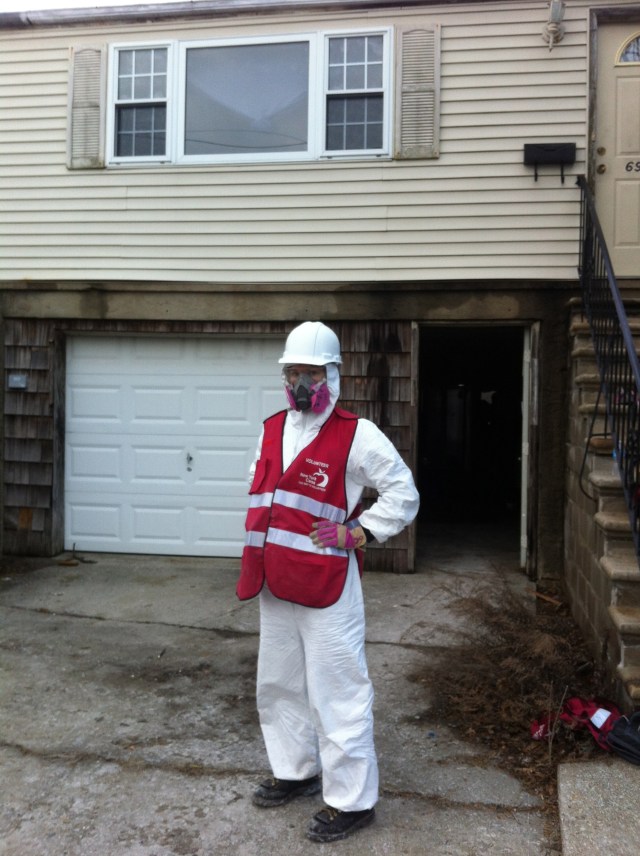
We set to work immediately at the site, a duplex a couple blocks from the beach with one unit in a finished basement – our patient. At first glance, the home looked mostly fine. Tasteful orange paint and hardwood floors decorated the unit. Clearly the area had not been used since before the storm – pots of water sat on the table, faithful to the recommendation to store water as the storm arrived, in case of water system failures. We began our work.
I couldn’t help but think of Kurt Vonnegut’s passage in Slaughterhouse Five, where he describes in reverse the bombing of Dresden, including passages such as: “The bombers opened their bomb bay doors, exerted a miraculous magnetism which shrunk the fires, gathered them into cylindrical steel containers, and lifted the containers into the bellies of the planes.”
Except instead of backwards bombing, we were backwards building houses.
First, we turned off the water and electricity. Then, we removed doors, furniture, and light-switch and outlet covers. Next, we carefully removed trim along the floor. Then, we pulled out sheetrock panels, starting from the floor. Despite the apparent legitimacy of the apartment, every panel along the floor was spongy with water – nearly two months after the storm – and the back of every panel was covered with mold of every color. I spent over two hours pulling nails out of the framing of the apartment. The goal is to leave the apartment ready to be rebuilt. We pulled out the floor – which looked fine at the top, only to reveal still-soggy layers below which also needed removal.
The homeowner, a black woman in her 50’s with a strong accent, watched and advised as we worked. After lunch, the team started to clearly become frustrated with a certain kind of metal trim bordering all the internal doors. The trim was extremely obstinate about its removal. I had been levering on one segment for several minutes when the homeowner came up next to me with a crowbar. “Let me try it!” she said, and I stepped aside. With the determination a person can only have about constructively deconstructing their own home, she attacked the trim and pried it off in sheer seconds. From that point, the volunteers doubled their efforts and successfully removed the rest of the metal trim.
On the school bus back to Manhattan, our Coordinator congratulated us. We had a successful day. With 13 volunteers, we managed to “muck out” 3 houses – more than the previous day’s 20+ people had accomplished. From this point, the homeowners can move forward with rebuilding. Our Coordinator finished by asking us to come back, and send friends. “We’re getting through it!” He said. “We only have 500 houses left!”

 panyck